TURBULENT PENETRATION
TURBULENT PENETRATION refers to the procedure and airspeed used when an aircraft must enter or pass through significant turbulence. Each aircraft has a recommended turbulent air penetration speed, calculated to reduce structural stress while maintaining enough control authority. Flying too fast can expose the airframe to excessive loads from sudden gusts. Flying too slowly can reduce the margin above stall. The phrase describes a disciplined compromise: slow enough to absorb violent air movement, fast enough to keep the aircraft controllable.
From an aviation perspective, the term is compelling because it strips away the comfort associated with high-altitude travel. A business jet may appear serene from the cabin, but it is moving through an unstable fluid environment. Turbulent penetration names the moment when the aircraft must stop optimizing for speed and begin optimizing for survival, stability, and structural tolerance. It is a calculated negotiation with weather.
Art historically, the work is interesting because the phrase operates as found language that exceeds its original purpose. In a manual, it is technical and neutral. Removed from that setting and placed on a mirror or sky painting, it becomes strange, physical, and psychologically charged. On a mirror, TURBULENT PENETRATION interrupts the viewer’s reflection with a phrase of instability and entry, turning self-image into an encounter with pressure and resistance. On a sky painting, gradient, or cloud field, the text cuts through atmospheric calm and reveals the hidden violence inside air itself. The absence of an underscore gives it procedural finality. It reads less like a prompt than a condition already entered.
Edition
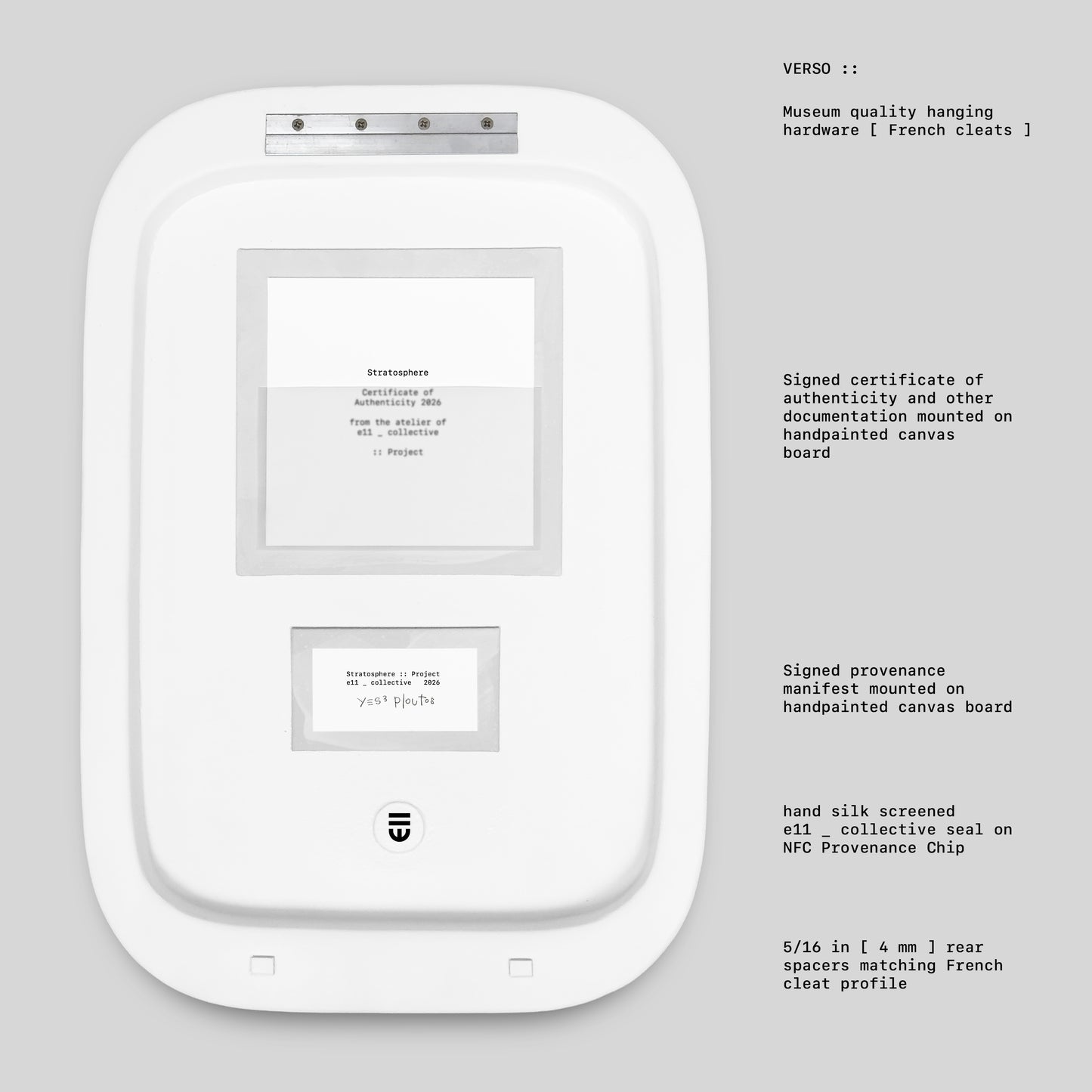
Individually produced work. Mounted to float on a shaped panel finished in automotive paint. Signed and dated on an affixed label. Accompanied by a signed certificate of authenticity and embedded RFID authentication chip.
Materials
Automotive paint, acrylic, polymer and varnish on mirror, mounted with sealed engineered wood fiber panels. Executed with proprietary airbrush and silkscreen techniques.
Year
2026
Dimensions
15 x 22 x 3.25 in (38 x 56 x 8 cm)
Couldn't load pickup availability
Share